


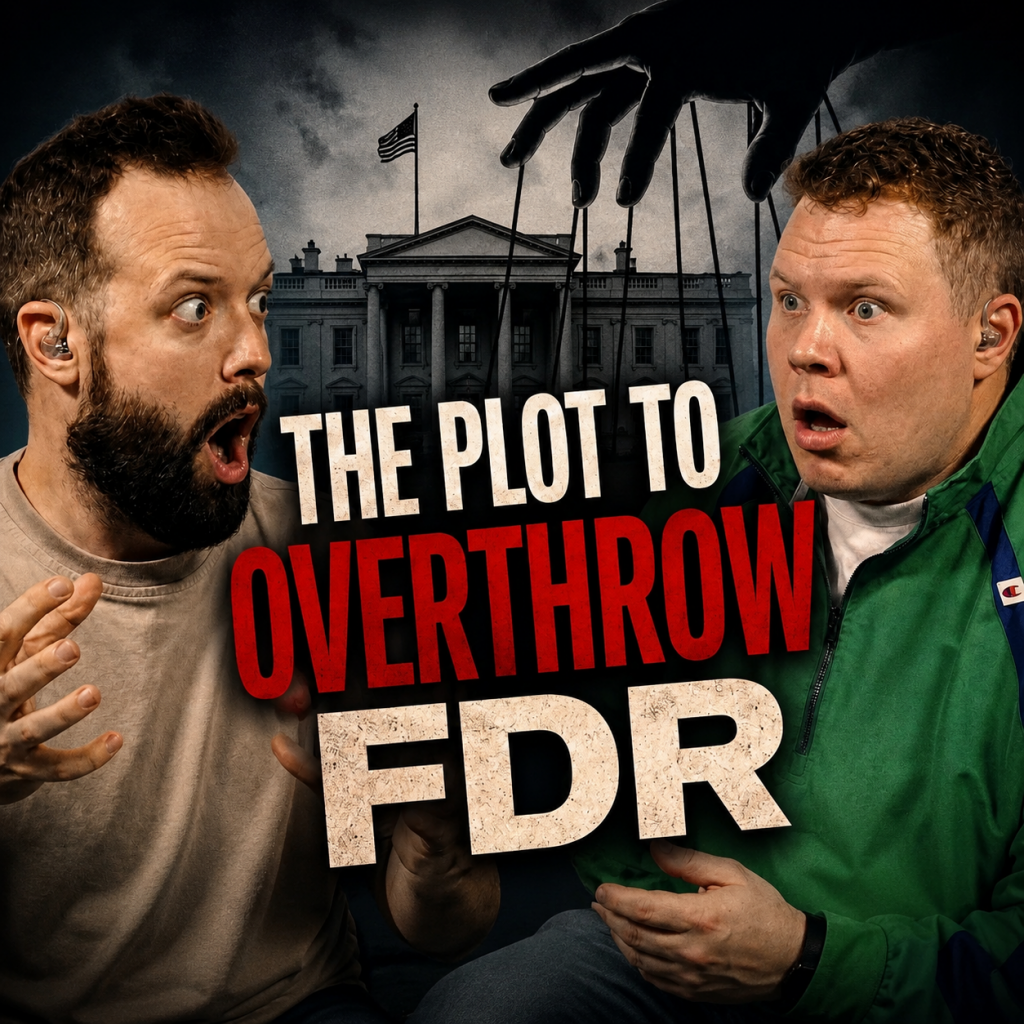
Imagine you’re a retired war hero, just chilling at home, enjoying your golden years. A limo pulls into your driveway. A guy with a fat cigar steps out, walks up to your door, and offers you a briefcase full of cash. Then he asks you to raise a private army, march on Washington, and overthrow the President of the United States. What do you do?
If you’re Smedley Butler, you say no. And then you tell everybody.
This week on TILLN, Jaron and Tim went deep on one of the most decorated Marines in American history — a man whose name sounds like a Victorian cartoon character but whose résumé reads like an action movie. And the wild part? Most people have never even heard of him.
A Marine Who Crawled Through a Drainage Pipe to Win
Let’s start with the legend. Smedley Butler enlisted at 16 to fight in the Spanish-American War because he just believed in the cause. From there, he became a career Marine and racked up an absolutely insane list of accomplishments — including being one of only 19 people to receive the Medal of Honor twice.
How’d he earn them? Well, one time his unit needed to take a rebel fortress that was considered impenetrable. Instead of storming the gates like a normal person, Butler found a two-foot-wide drainage pipe and crawled through it with a sergeant, popping out right into the enemy courtyard.
Another time, outnumbered six to one in the Philippines, he got shot square in the chest. The bullet hit a button, drove it into his skin, and knocked him out cold. When he woke up, he realized he wasn’t actually mortally wounded… so he just got up and went back to work. As Tim pointed out, most of us would’ve taken that as a divine sign to retire on the spot.
The Banana Republics and “War Is a Racket”
Here’s where the story gets uncomfortable. Butler spent his career doing exactly the kind of “special operations” that built the era of the banana republics — and no, not the store your jeans came from. (Though, fun fact: it’s the same parent company as Gap. You’re welcome.)
Back then, the U.S. military was regularly sent in to overthrow governments, crush rebellions, and seize control of natural resources — bananas, oil, sugar — all to benefit American corporations. Butler later admitted he was on the wrong side of most of it. In his famous War Is a Racket speech, he confessed he’d spent his career as “a high-class muscle man for big business, for Wall Street, and for the bankers.”
The chilling kicker? He said he’d suspected he was part of a racket the whole time. Now he was sure of it.
The Bonus Army and the Veterans Who Loved Him
Fast-forward to the Great Depression. After WWI, the government had promised veterans “bonus bonds” — payable in 1945. But these guys were broke now. So in 1932, thousands of veterans marched on Washington in what became the Bonus Army, demanding their money early.
It was peaceful. It was basically Occupy Washington. And it ended with President Hoover sending in the actual army — tanks, gas, the works — to burn down the camp of fellow war heroes. Two veterans died. Butler stood firmly with the marchers, cementing his status as the one general the veterans truly trusted.
And that trust is exactly what made him the perfect target for the most dangerous people in America.
The Business Plot: A Coup Hiding in a Briefcase
Enter Gerald McGuire, a Wall Street bond salesman who showed up at Butler’s door. He buttered him up, handed him a speech designed to turn veterans against FDR’s New Deal, and got physically thrown out of the house for his trouble.
But McGuire didn’t quit. He toured Europe studying fascism — under Mussolini himself — convinced it was the solution to those pesky unions and labor rights. Then he came back, tracked Butler down, and opened a briefcase with $30,000 in cash. The pitch: the wealthiest men in America — including JP Morgan’s personal attorney and heirs to massive fortunes — would pay Butler $300 million to raise an army and overthrow the U.S. government.
They picked the one guy guaranteed to rat them out. Butler played along, gathered every name and detail, fed it to a reporter named Paul French to verify, and then took the whole thing to Congress.
The Coup That Vanished
The McCormack-Dickstein Committee concluded the plot was real. America’s corporate elite had genuinely conspired to overthrow the government. And the punishment for these men? Absolutely nothing. The reasoning: these organizations were too big to fail, and in the middle of the Depression, holding them accountable might fracture the economy.
Sound familiar? Jaron and Tim couldn’t help but connect the dots to today — from “too big to fail” to drunk celebrities name-dropping the President, the powerful have always found a way to slip the cuffs.
From magic card tricks to AI doomsday talk to a finger-licking incident we will not be elaborating on, this episode is peak TILLN chaos wrapped around a genuinely jaw-dropping piece of forgotten history. Smedley Butler is the man who could’ve been a dictator’s puppet — and instead became a whistleblower nobody remembers.
Things I Learned Last Night is an educational comedy podcast where best friends Jaron Myers and Tim Stone talk about random topics and have fun all along the way. If you like learning and laughing a lot while you do, you’ll love TILLN. Watch or listen to this episode right now!
Sources
Related Episodes
Tell Us What You Think of This Content!
Don’t forget to share it with your friends!