


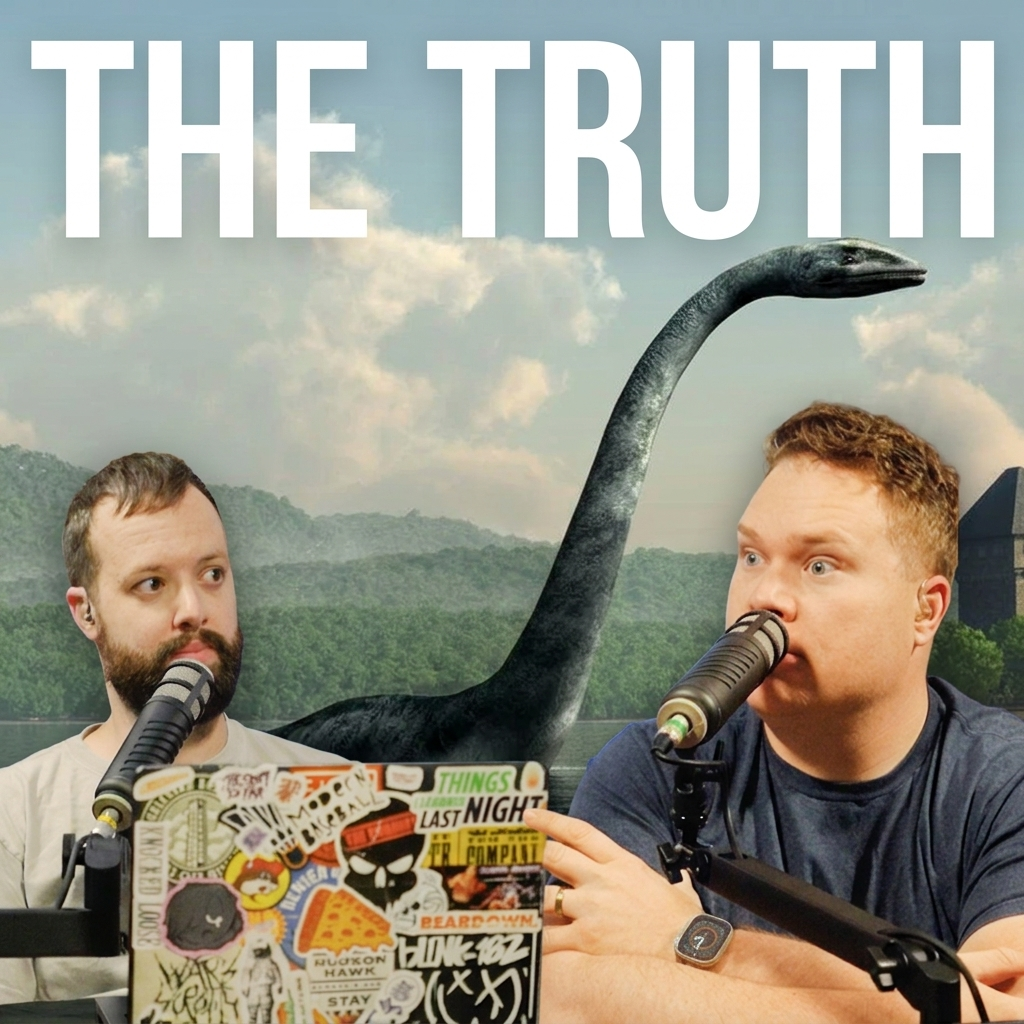
Imagine you’re at a funeral in the Scottish Highlands in 565 AD. You’re mourning a friend who was just killed by a water monster, when suddenly a monk shouts, “Hey, why don’t you swim across the lake and see if we can get that monster out of there!” And one of you… actually does it. This is where the legend of the Loch Ness Monster begins — and somehow it only gets weirder from there.
Grab a snack (maybe not boneless wings, we’ll explain later), because this episode of TILLN went deep. Pun absolutely intended.
A Saint, a Sea Monster, and a Mass Baptism
The oldest known Nessie sighting comes from Saint Columba — a name Jaron is now convinced sounds like “the gigantic eighth-grader who just transferred to your school.” According to the Life of Saint Columbus, Columba was doing missionary work in Scotland when he came across locals burying a man killed by a “water monster” in the River Ness.
So naturally, Columba told a fellow monk to swim across the water as bait. When the beast surfaced with a terrifying roar, Columba raised his hand, made the sign of the cross, and commanded it: “Go no further. Do not touch the man.” The creature reportedly froze “as if pulled back by a rope” and fled in terror. Everyone present immediately converted to Christianity.
Here’s the catch: this story was written down over 100 years after Columba’s death by a man named Adomnán of Iona. So… reliable? Eh. But it planted a seed in local folklore that would lie dormant for nearly 1,300 years of total historical silence.
The Dinosaur Theory (And Why It Doesn’t Add Up)
Fast forward to the 1800s, when sightings suddenly pick back up. In 1820, fossil pioneer Mary Anning discovered the first complete Plesiosaur skeleton — a long-necked marine reptile that looks suspiciously Loch Ness Monster-y. At 10 to 16 feet long with that iconic serpentine neck, it fit the legend perfectly.
Could a surviving Plesiosaur be lurking in the loch? Loch Ness is bizarre — a long, deep, river-like lake connected to the sea on one end. Scientists did the math, though, and here’s where the dream dies: Plesiosaurs went extinct 65 million years ago. And even if one had survived, there’d need to be a whole breeding population to keep the species going. The problem? The loch barely holds enough fish to feed a single Plesiosaur. It would eat through the food supply faster than it could replenish, essentially starving itself to extinction. Case closed. Mostly.
The Famous Photo Is a Toy Submarine
Now for the big one. In 1933, a businessman and his university-graduate wife (the paper made sure to mention she was smart) reported seeing something whale-like thrashing in the water. The story went, in Jaron’s words, “buckwild.”
Enter big game hunter Marmaduke Wetherell, hired by the Daily Mail. He couldn’t find the monster, so he faked footprints using a dried hippo foot (apparently a common item back then?). When the paper exposed him, Wetherell got petty. He recruited a respected surgeon to submit the photo — you know the one, the black-and-white silhouette everyone’s seen.
Except it was a toy submarine with a little clay head molded to look like a Plesiosaur. A member of Wetherell’s own group eventually confessed. The most iconic cryptid photo in history is a bath toy. And yet — believers shrugged, because the myth existed long before the photo did.
Sonar, DNA, and Giant Eels
Modern science has taken real swings at the loch. In 1987, marine biologist Adrian Shine (described by Tim as “hot Santa”) launched Operation Deep Scan — 24 boats blasting sonar across the entire lake. They found a few anomalies larger than a shark, some of which moved between scans. Spooky, but probably debris. Or, you know, maybe not.
Then in 2018, professor Neil Gemmell ran a full DNA analysis. The verdict? Zero reptile, sturgeon, or catfish DNA. But tons of European eel DNA — enough that there’s almost certainly at least one eel in the loch over a meter long. Picture a three-foot eel poking out of dark, choppy water when you’re already expecting a monster. Your brain fills in the rest.
So What’s Really Going On?
Jaron and Tim landed on something genuinely fascinating: the power of suggestion. For most of human history, people constantly encountered things they’d never seen before. Giraffes, hippos, dragons — all equally unbelievable to someone who’d never left their village. As Tim put it, “I shouldn’t know about hippos.” We live in a world that’s over-seen; they lived in one that was wide open to wonder.
Nessie is probably a 1,500-year-old game of telephone that started with a monk, got revived by a hoaxer, and lives on because we want it to. From boneless wing near-death experiences to hot Santa marine biologists, this is Jaron and Tim at their rambling, hilarious best — and honestly, the real monster might just be our own imaginations.
Things I Learned Last Night is an educational comedy podcast where best friends Jaron Myers and Tim Stone talk about random topics and have fun all along the way. If you like learning and laughing a lot while you do, you’ll love TILLN. Watch or listen to this episode right now!
Sources
I have strong sources for both central claims. Both Wikipedia pages are confirmed live and authoritative, covering the 565 AD St. Columba story and the 1934 surgeon’s photograph hoax.
- Loch Ness Monster – Wikipedia
- River Ness – Wikipedia
- M. A. Wetherell – Wikipedia
- ‘The Surgeon’s Photograph’ of the Loch Ness Monster – The Victorian Web