


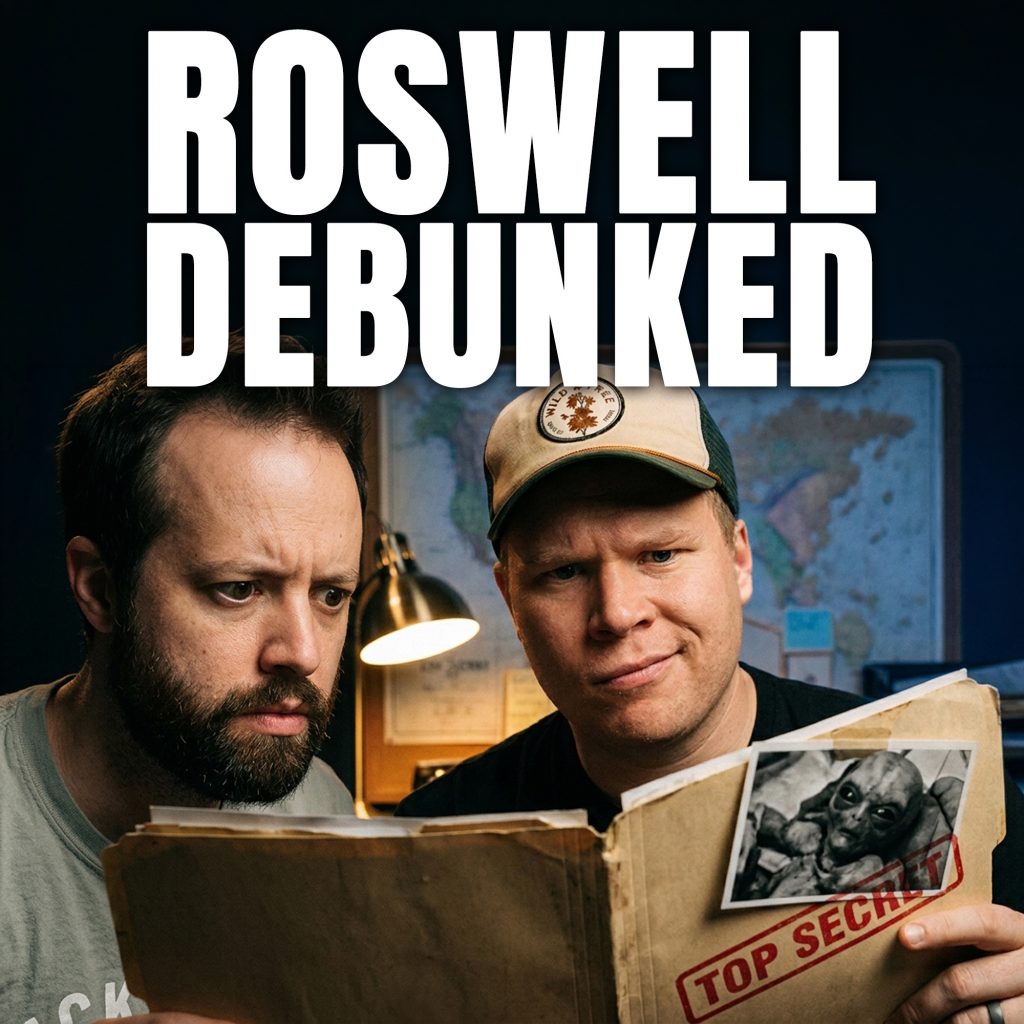
Roswell. The name alone conjures images of flying saucers, alien bodies, and government cover-ups. For decades, the 1947 incident in Roswell, New Mexico, has been the cornerstone of UFO lore, a foundational event that sparked countless theories and fueled the public’s fascination with extraterrestrial life. But what really happened on that remote ranch more than 75 years ago? Let’s delve into the layers of myth, mystery, and eventual declassification that define the Roswell Incident.
The Discovery: A Rancher’s Strange Find
Our story begins in late June 1947, when rancher W.W. “Mac” Brazel discovered a sprawling field of unusual debris on his property outside Roswell. He described the scattered remnants as highly peculiar – akin to tin foil, rubber strips, paper, and wooden sticks. Initially, he didn’t give it much thought, even attempting to use some of the sticks to build a dam. However, a local phenomenon would soon give this debris new significance.
Lights in the New Mexico Sky
A few days prior to Brazel contacting local authorities, on July 2nd, a severe thunderstorm swept through the Roswell area. Eyewitnesses around town reported seeing strange, pulsating lights in the sky – distinct from lightning – adding to the eerie atmosphere. Hearing these tales, Brazel connected them to the strange objects on his land and decided to report his find.
The Military’s Initial Response: A Flying Saucer Captured?
On July 6th, Brazel contacted the sheriff, who, recognizing the unusual nature of the debris, promptly alerted the Roswell Army Air Field (RAAF). Major Jesse Marcel, an intelligence officer from the RAAF’s 509th Composite Group, was dispatched to the scene. The 509th was no ordinary unit; it was the world’s only nuclear-capable air division at the time, responsible for the atomic bombings of Hiroshima and Nagasaki. This detail underscores the unit’s strategic importance and capabilities.
Marcel and a counterintelligence agent collected pieces of the debris, boxing them up and returning to base. Before heading back, Marcel made an unusual stop at his home, eager to show his son, Jesse Jr., the extraordinary materials. Jesse Jr. would later recall seeing metallic-like foil that would return to its original shape after being crumpled, and small “I-beams” inscribed with purple hieroglyphs.
The Sensational Headline
Upon learning of the discovery, the RAAF’s public information officer, with the Colonel’s clearance, issued a press release on July 8th. The announcement was electrifying: the RAAF had recovered a “flying disc” or “flying saucer.” Newspapers across the globe immediately picked up the story, reporting on the alleged alien crash in Roswell. The world was captivated.
The Swift Retraction: A Weather Balloon?
However, the sensation was short-lived. Within hours, higher-ups at Fort Worth Army Air Field in Texas intervened. Marcel and his team were ordered to fly to Fort Worth, bringing the debris with them. Immediately following this meeting, a press conference was held, where General Roger Ramey, Marcel’s commanding officer, announced a retraction. The recovered object, he stated, was merely a weather balloon. Photographs were released showing Marcel posing with what appeared to be common weather balloon wreckage.
For nearly 30 years, the Roswell incident faded from public consciousness. The government’s explanation, delivered quickly and authoritatively, was widely accepted in an era when trust in institutions, particularly after World War II, was high.
The Resurgence: Whistleblowers and Expanding Narratives
The narrative dramatically shifted in the late 1970s. A retired Jesse Marcel, now an old man, began speaking out. He claimed the weather balloon story was a cover-up, exposing that the debris he posed with in the Fort Worth photos was not the material originally recovered. He asserted that the original, unworldly debris had been swapped out.
This revelation ignited a new wave of interest. Authors and amateur researchers began interviewing other alleged witnesses from the Roswell area. Over time, the story grew more elaborate, with claims emerging of:
- A debris field stretching for miles, not just hundreds of yards.
- Townspeople witnessing the craft crash during the storm.
- The discovery of charred alien bodies at the crash site.
- A local mortician being contracted to make small coffins.
- A nurse assisting with autopsies on extraterrestrial beings.
These later additions often merged personal memories with existing UFO lore and other incidents, making it difficult to discern original accounts from later embellishments.
Analyzing the “General Ramey Letter”
One intriguing piece of evidence from the Fort Worth press conference was a photograph of General Ramey holding a document. With advancements in technology, some researchers claimed to have enhanced the image, interpreting phrases like “victims of the wreck” in the letter. While controversial and not universally accepted by experts, this detail further fueled suspicions of a cover-up.
The Declassified Truth: Project Mogul
In the 1990s, the U.S. Air Force issued a declassified report, attempting to provide a definitive explanation for the Roswell incident. They revealed that the object was indeed a high-altitude balloon, but not just any weather balloon. It was from a top-secret project called Project Mogul.
What Was Project Mogul?
Project Mogul involved arrays of balloons carrying low-frequency microphones, designed to detect sound waves from Soviet atomic bomb tests. These arrays were massive, some stretching 600 feet, and were strategically floated over the United States.
Crucially, the materials used in Project Mogul bore striking resemblances to the descriptions of the Roswell debris:
- Metallic-like foil: The arrays used reflective tape to avoid radar detection, made by a toy company from New York, which used limited supplies during post-war shortages.
- Wooden sticks/fragments: The toy company used balsa wood I-beams to construct parts of the array.
- Purple hieroglyphs: The reflective tape featured purple floral designs. Over time, and exposed to New Mexico heat and rain, the tape’s adhesive could have failed, causing the purple dye to bleed onto the balsa wood, creating unusual, hieroglyph-like patterns.
As for the alleged alien bodies, the Air Force suggested these were likely a combination of “suggestive memory” conflating several events:
- Crash test dummies: Later tests in the 1950s in Roswell involved dropping crash test dummies from balloons to test parachutes, creating a visual that could be misremembered.
- Aircraft crash: A horrific military plane crash near Roswell, where a reporter described seeing “little charred bodies,” may have contributed to stories of alien cadavers.
The Enduring Allure of the Unknown
The Air Force’s explanation for Roswell, while offering plausible details for each mysterious element, has not entirely quelled the belief in extraterrestrial involvement for many. Skeptics point to the quick retraction and subsequent secrecy as evidence of a deeper cover-up, suggesting the government realized the “alien” narrative was far more effective at concealing Project Mogul than a simple weather balloon story.
Indeed, some speculate that the military observed the public’s swift acceptance of an alien explanation for an unknown object. This, they argue, potentially informed future strategies for misdirection when advanced, classified aircraft (like spy planes or stealth bombers) were sighted, attributing them to extraterrestrial craft rather than revealing sensitive military technology.
Whether a genuine UFO crash or a cleverly concealed Cold War secret, the Roswell incident remains a powerful symbol of humanity’s fascination with the unknown and the enduring distrust of official narratives. It serves as a stark reminder of how easily, and how deeply, a story can embed itself in our collective consciousness, shaping our understanding of the world – and beyond.
Things I Learned Last Night is an educational comedy podcast where best friends Jaron Myers and Tim Stone talk about random topics and have fun all along the way. If you like learning and laughing a lot while you do, you’ll love TILLN. Watch or listen to this episode right now!
Sources
Related Episodes
Tell Us What You Think of This Content!
Don’t forget to share it with your friends!