


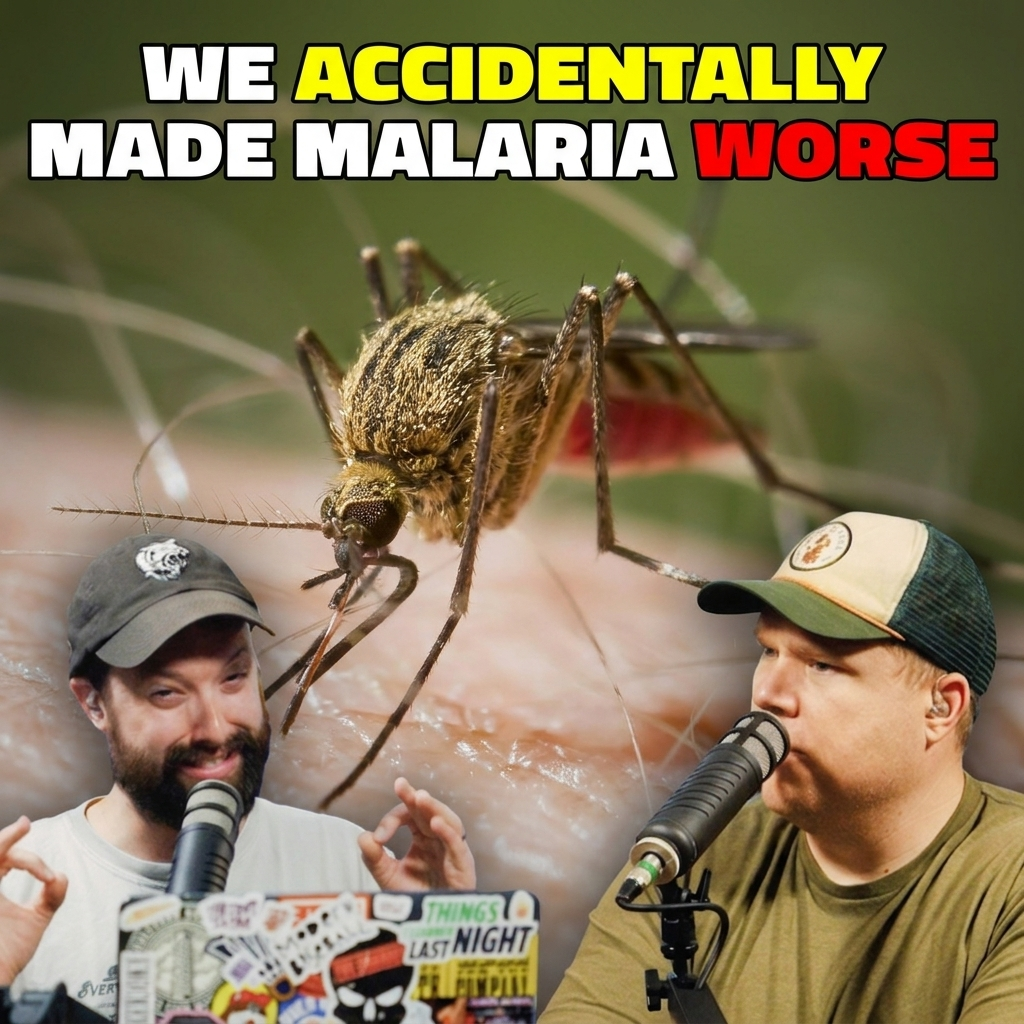
Malaria is a parasitic disease transmitted by mosquitoes, and by some estimates it has killed more humans than any other cause. One figure puts the toll at roughly 5 percent of everyone who has ever lived. The effort to wipe it out began in earnest during World War II, when the United States military confronted a disease that was taking soldiers out of combat faster than the enemy. The man at the center of that effort was Fred Soper, a public health official from Kansas whose approach would reshape how the world fought the disease.
How malaria works
Malaria spreads through a cycle that involves both humans and mosquitoes. When an infected mosquito bites a person, it injects the parasite into the bloodstream. The parasite travels to the liver, where it multiplies, then moves back into the blood and attacks red blood cells. When another mosquito bites that person, it picks up the parasite, which develops inside the insect before being passed to the next person. Because the parasite has a development stage in both hosts, it spreads quickly through a population where mosquitoes and people are in constant contact.
In a person, the illness often begins like a severe flu, with high fever lasting a couple of weeks. In worse cases the liver shuts down, red blood cells are destroyed, the spleen ruptures, or the lungs fill with fluid. Some of these effects strike after the initial illness seems to have passed, which made the disease especially dangerous for soldiers who returned to duty believing they had recovered.
MacArthur’s problem and Soper’s method
In the Pacific theater, General Douglas MacArthur reported that for every three of his soldiers, one was on the front line, one was on leave, and one was in the hospital with malaria. He pressed the government to do something about it. Officials responded by considering a goal that had never been achieved before: the complete eradication of a disease.
They turned to Fred Soper, who had been testing a new method in Brazil. Where most anti-malaria work relied on drugs to prevent and treat infection in people, Soper focused on killing the mosquitoes. He used an insecticide called DDT, which had a useful property: once sprayed on a surface, it remained lethal to mosquitoes for months. Any insect that landed on a treated surface would be killed. Soper divided a region of Brazil, which carried a particularly dangerous strain, into a grid and organized teams to spray the entire area on a schedule so that no part was ever left uncovered. The method worked. When the government asked him to apply it in the Pacific, malaria was brought under control there within months.
Spreading the program worldwide
After the war, the United States helped establish the World Health Organization, and in the late 1940s it began applying Soper’s method at home. Malaria had been largely a Southern problem. In South Carolina, a person had about a 16 percent chance of dying of it before adulthood. Between 1947 and 1951, the government sprayed 6.5 million homes across the South and drained wetlands to reduce mosquito breeding grounds. Domestic malaria was eradicated by 1951.
In 1955, the Eighth World Health Assembly convened in Mexico City with 150 nations and adopted a plan to spray for mosquitoes across every affected country, with member nations contributing financially. The assembly voted against extending the campaign into sub-Saharan Africa. The region had the most lethal strain, but it was vast, rural, expensive to reach, and dangerous to work in. By the 1960s, malaria had been pushed out of nearly every part of the world except sub-Saharan Africa.
President John F. Kennedy pushed for foreign assistance to bring the campaign there. Pilot programs in Zanzibar and Swaziland drove cases to near zero, and later efforts reached Grenada and St. Lucia. By the end of the 1960s, the United States withdrew its funding, leaving much of Africa untreated.
Resistance, bed nets, and a reversal
Where DDT had been used but not finished the job, mosquitoes evolved resistance to it through the 1970s and 1980s. In 2003, the United States launched the President’s Malaria Initiative. One of its key tools was the insecticide-treated bed net, which cost about two dollars, protected sleepers directly, and killed mosquitoes that landed on it. By 2014, malaria had fallen to its lowest level ever recorded, even in sub-Saharan Africa.
Cases began rising again in 2017. Warmer climates let mosquitoes survive in regions further north and south that had never been treated. In 2025, funding cuts from the United States reduced the World Health Organization’s budget for the effort from 9.3 billion to 3.9 billion dollars, leaving more of the globe uncovered as the disease continues to spread.
Things I Learned Last Night is an educational comedy podcast where best friends Jaron Myers and Tim Stone talk about random topics and have fun all along the way. If you like learning and laughing a lot while you do, you’ll love TILLN. Watch or listen to this episode right now!
Sources
- Fred Soper (Wikipedia)
- Fred Soper, DrPH, MPH (Johns Hopkins Bloomberg School of Public Health)
- The Fred L. Soper Papers, Profiles in Science (U.S. National Library of Medicine)
- Some Lessons for the Future from the Global Malaria Eradication Programme (1955-1969), PMC