


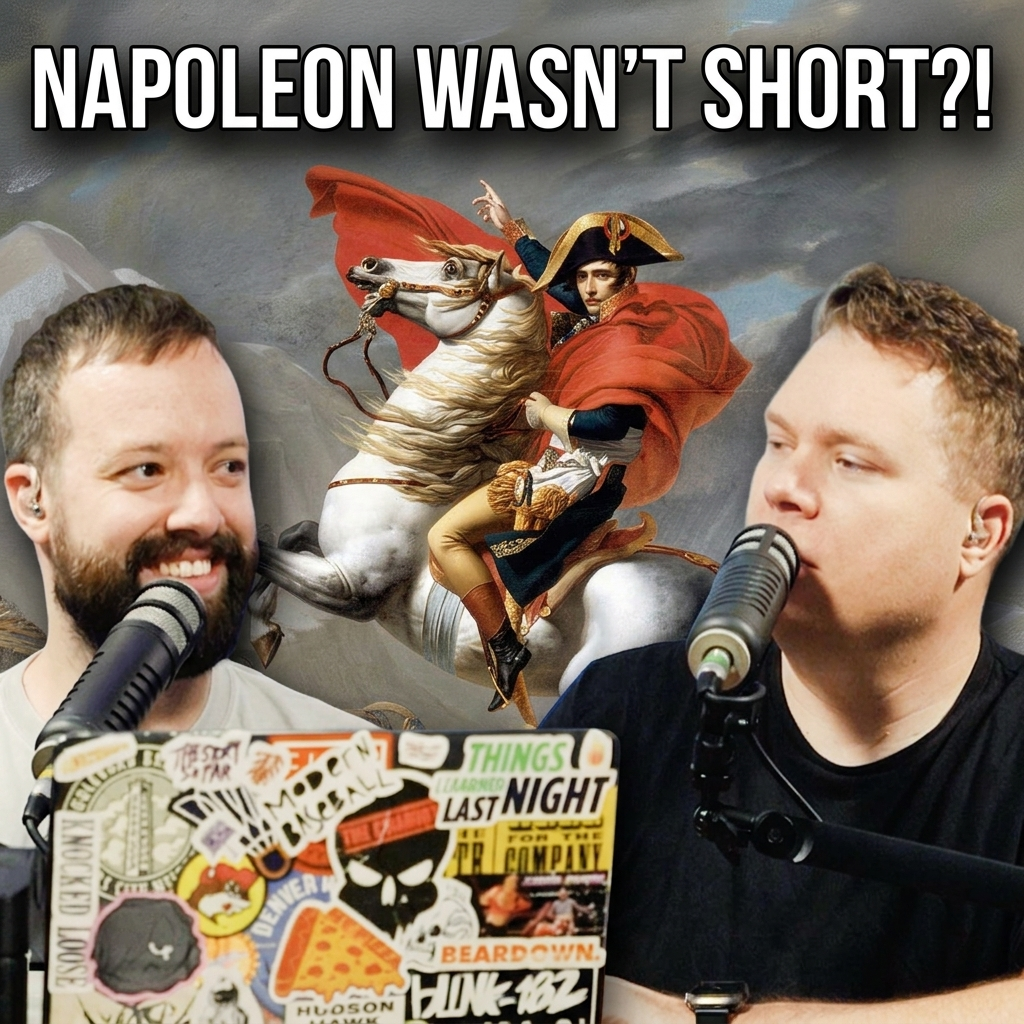
Imagine waking up one random Tuesday morning, nudging your spouse awake, and whispering, “Hey. It’s time.” Time for what? To seize control of an entire country, obviously. That’s exactly what Napoleon Bonaparte did on November 9th, 1799 — and by 2 a.m. the next morning, through a series of carefully orchestrated meetings, he had legally couped his way into running France. This week, Jaron and Tim went deep on one of history’s most consequential (and most misunderstood) figures. And no — he wasn’t that short.
Let’s Clear Up the Short Thing Right Now
Here’s the fact that’s going to ruin dinner parties: Napoleon was 5’7″. That was average-to-tall for France at the time. For context, the average Roman gladiator was 5’5″, and the average 18th-century man clocked in around 5’6″. So why do we all picture a tiny, angry man in a big hat? Honestly, a lot of it is myth and propaganda that just… stuck.
Meanwhile, George Washington was a towering 6’2″ — a literal giant for his era. (The guys floated a theory that we’re all getting taller because the sun is physically stretching us. Science says it’s actually just better nutrition and less disease letting people hit their genetic height potential. Boring, but probably correct.)
So let’s set the record straight: Napoleon was an upper-end-of-average guy. A normal, borderline-big guy. Say it with us.
A Mama’s Boy From Corsica
Napoleon was born in 1769 on Corsica — a French island that’s honestly way closer to Italy. He grew up speaking Italian, not French, and he was raised by a mother who instilled serious discipline in him. The man adored her. He talked about her for years, and when he installed puppet leaders across the nations he conquered, guess who got the jobs? His literal brothers. His logic was basically: we came from the same incredible woman, so I know you’re great.
He shipped off to mainland France for Catholic school to learn French, then enrolled in military school. By his late teens he was a lieutenant in the middle of the Coalition Wars — a massive, messy series of seven or eight conflicts where the rest of Europe kept teaming up to take France down. Napoleon kept winning. And winning. And climbing.
From Consulate to Emperor (and the Code That Changed the World)
After his 1799 coup, Napoleon became Supreme Consulate — then, by the end of 1804, he just… crowned himself Emperor. There’s a famous painting of the coronation where he’s crowning his wife Josephine, and yes, he’s holding what looks suspiciously like one of those giant foam finger-pointers.
But here’s the genuinely fascinating part. In 1804, Napoleon released the Code Civil — the Napoleonic Code — a legal framework that’s since been adopted in some form by at least 120 countries. Before this, feudal France had neighborhoods with wildly different laws (kind of like how crossing a U.S. state line can suddenly make something illegal). Napoleon made law uniform and enforceable everywhere. He elevated the arts and sciences, ushered in Enlightenment-era policies, and turned France into the preeminent superpower of the moment. If you were French in this era? Honestly, pretty good time to be alive.
The Russia Disaster: When 655,000 Men Became 93,000
By 1812, Napoleon had most of Europe bowing to him — except Russia. So he did what Napoleon does: he marched in with an absolutely staggering army of 655,000 soldiers, planning to roll into Moscow and overthrow Tsar Alexander I.
He did not expect the Russians to be insane.
When Napoleon reached Moscow, he found it empty — and burned to the ground. The Russians had torched their own capital and retreated deeper into the mainland, betting he couldn’t survive a Russian winter. They were right. His army relied on horses that fed off the land, but there was nothing to eat. Historians calculated he needed four million pounds of feed a day. He lost 200,000 horses. By the time his army limped out of Russia, those 655,000 men had dwindled to 93,000.
It was the great humiliation of Napoleon — and it was all because the Russians said “good luck, have fun in the snow.”
Exile, a 100-Day Comeback, and a Suspiciously Small Tomb
France was over it. Napoleon got exiled to the island of Elba — then promptly escaped, marched back into Paris with 1,000 men, overthrew King Louis XVIII, and ruled again for 100 days before Europe said “okay, no.” His second exile landed him on remote Saint Helena off the coast of Africa, where he died in 1821 at age 51. His last words? “France. The army. The head of the army. Josephine.” (His first wife. He’d remarried twice. Awkward.)
The ripple effects were enormous: his invasion of Spain triggered Latin American independence movements, and the treaties built to prevent “another Napoleon” created an artificial century of peace that eventually boiled over into World War I.
As Jaron and Tim kept circling back to, it’s all connected — a mama’s boy from Corsica reshaping the modern world, one coup, code, and catastrophic winter at a time. And whether you walk away admiring the military genius or side-eyeing the self-crowning emperor energy, one thing’s for sure: the guys spent a solid chunk of this episode genuinely convinced his tomb looks too small for a 5’7″ man. Someone go measure it.
Things I Learned Last Night is an educational comedy podcast where best friends Jaron Myers and Tim Stone talk about random topics and have fun all along the way. If you like learning and laughing a lot while you do, you’ll love TILLN. Watch or listen to this episode right now!
Sources
- Napoleon complex (Wikipedia)
- Was Napoleon Short? Here’s the Truth About His Height (The Collector)
- 10 Myths about Napoleon Bonaparte (Shannon Selin)
- Head injuries of Roman gladiators (PubMed)