


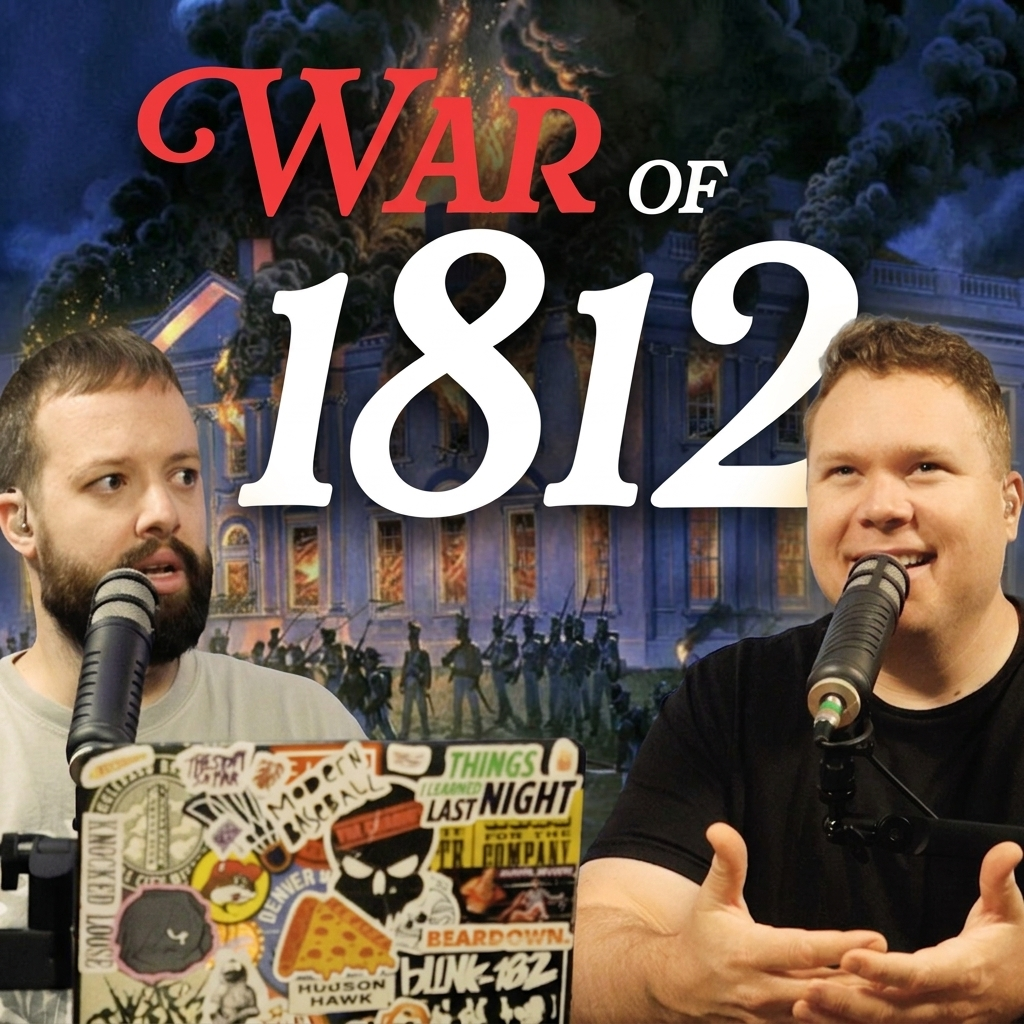
Imagine you’re a sailor. It’s the early 1800s, and you’re standing on the deck of your ship when suddenly another vessel pulls up alongside you. Armed men board. They line everyone up, point their fingers — “you, you, you, and you” — and just like that, you’re conscripted into a foreign navy. No trial. No paperwork. Just muskets pointed at your chest and a one-way ticket to a war you didn’t sign up for. That, believe it or not, is basically how the War of 1812 got started. And it only gets weirder from there.
The “Second War for Independence” (That Britain Barely Noticed)
Here’s the thing about the War of 1812 — it’s the war that hipsters and mustache guys at your local coffee shop know a suspicious amount about. And once you dig in, you understand why. It’s genuinely fascinating.
Even though America had technically won its independence about 30 years earlier, Great Britain was still treating the young nation like an annoying little sibling. “Yeah, you’re a country. But we’re in charge, okay?” Meanwhile, Britain was completely consumed with fighting Napoleon (who was going absolutely ham across Europe), plus dealing with the Luddites back home. America was, frankly, the bottom item on their to-do list.
That’s what makes this whole war so wild. The US declared war on a global superpower that was so busy it initially responded with the geopolitical equivalent of “shut up, we’re busy.”
Impressment: Grand Theft Auto on the High Seas
So why did Britain keep grabbing American sailors? Because conditions on British naval ships were horrific. We’re talking beatings, starvation, disease, and terrible discipline. So British sailors kept deserting and hopping onto cleaner, better-paying American trade ships — and many of them became US citizens in the process.
The problem? You couldn’t tell them apart. America had only been its own thing for 30 years, so basically everyone still sounded British. So Britain enacted “impressment” — pulling up to American ships and just… taking people. And on top of that, they passed the Orders in Council, which let them seize entire ships and cargo to fund their war against Napoleon. They were, as Tim and Jaron put it, Grand Theft Auto-ing the ocean.
The breaking point came with the Chesapeake-Leopard Affair in 1807, when a British ship didn’t even bother boarding politely — it just opened fire, killed three American sailors, and dragged off four more. That’s the moment the tide of public opinion started to turn.
The Native American Alliance That History Forgot
Here’s the part of the story that doesn’t get told enough. While all this ocean drama was happening, the US was also pushing westward — right into land occupied by Native nations. Two leaders, Tecumseh and his brother Tenskwatawa, realized they couldn’t stop American expansion alone. So they built the Pan-Indian Confederacy, uniting tribes from the Great Lakes all the way south into what was essentially a Native American NATO.
Their argument was beautiful and radical: this land isn’t anybody’s to take. It’s just where people live. And when it became clear at the Battle of Tippecanoe (1811) that Britain was secretly aggravating and possibly funding this conflict, President Madison finally asked Congress for the first declaration of war in US history.
New England Almost Bailed (And Britain Burned Down the White House)
Not everyone was on board. Cities like Boston relied on trade with Britain for their entire economy, so a chunk of New England seriously considered breaking off to form their own nation. They gathered secretly in Hartford and drafted resolutions — including some genuinely interesting ideas like limiting presidents to a single term, and some genuinely terrible ones rooted in the wrong reasons.
Meanwhile, once Napoleon got exiled, Britain finally had time to focus. They marched into Washington and burned down the White House and national monuments, basically saying, “Don’t forget who you’re talking to.”
By 1814, it genuinely looked like the United States might not survive.
The War That Ended Twice (And Somebody Forgot to Mention It)
On December 24th, 1814 — Christmas Eve, you monsters — both exhausted nations signed the Treaty of Ghent. And the treaty was essentially: “Let’s pretend none of this happened.” Pre-war borders restored. Impressment? Sure, whatever. Everyone was just too tired.
But here’s the punchline. News traveled slowly. So on January 8th, 1815, Andrew Jackson fought the Battle of New Orleans — completely unaware the war was already over. With 4,000 men against Britain’s 8,400, he pulled off a staggering victory in about 40 minutes. Britain lost over 2,000 men. America lost a handful. The battle was pointless in every strategic sense, but it turned Andrew Jackson into a folk hero and eventually launched him into the presidency.
Oh, and one more thing — during the bombardment of Fort McHenry, a lawyer named Francis Scott Key sat detained on a British ship, watching 25 hours of shelling, and poetically journaled about it. That journaling? Yeah, that became the national anthem.
So who won? Honestly, it was a draw between the US and Britain. But the Native nations lost enormously, ceding huge swaths of the Midwest and accelerating American westward expansion. Somewhere in this episode, Jaron and Tim also manage to detour into secret tunnels inside Mount Rushmore, the Hat Man teaching people accordion, and whether you can start a fire with your bare hands in front of an Eagle Scout. It’s a ride — and somehow it all circles back to 1812.
Things I Learned Last Night is an educational comedy podcast where best friends Jaron Myers and Tim Stone talk about random topics and have fun all along the way. If you like learning and laughing a lot while you do, you’ll love TILLN. Watch or listen to this episode right now!
Sources
- War of 1812 | History, Summary, Causes, Effects, Timeline, Facts, & Significance | Britannica
- Impressment and the War of 1812 (U.S. National Park Service)
- War of 1812 Overview (1812-1815): U.S. Navy & America’s Second Fight for Independence – USS Constitution Museum
- The War of 1812 (1812–1815) | Encyclopedia.com